Other people's drinks in the DJ booth — and where to put them
Guests, promoters and the next DJ all put drinks in your booth. Why 'no drinks in the booth' does not hold — and how to give those drinks a real place.
"No drinks in the booth" is one of the most repeated sentences in DJ culture and one of the least effective, because the person who breaks it has usually never heard it. It is a rule addressed to the DJ about the behaviour of strangers. Tonight it gets broken by a guest making a request, a friend leaning in to talk, a promoter being generous, or the DJ coming on after you — and in most of those cases there was no moment you could have stopped it.
This is about that half of it: the drinks that arrive in someone else's hand. Your own can walking itself across a vibrating table is a different failure with different physics, covered on why drinks tip in the booth.
The usual account of the guest — drunk, rude, no respect for gear — is not wrong so much as useless. It gives you nothing to act on. The height does.
Backstage.dj's 2026 tech-rider guide tells DJs to write the number into their own contract: a standard booth table height of 90 cm. That is 35.4 inches. Sebring Design Build's furniture-height guide puts a counter-height table or kitchen island at "34 to 36 inches from the floor to the surface, with 36 inches matching the standard height of a residential kitchen countertop." The figure the trade tells you to demand lands inside the kitchen-counter band, a shade under the countertop itself. The trade reaches for that reference object unprompted, too: Digital DJ Tips, asked what height a standing DJ desk should be, ends by telling you to "measure the height of your kitchen work surface from the floor." The mobile rig sits one band lower — a folding banquet table under a scrim is at dining-table height, 28 to 30 inches on the same furniture guide.
Club booth or wedding rig, then, the drink surface is at a height adults have spent years setting glasses down on without deciding to.
Now the room around it. A dance floor has almost nothing horizontal on it — that is most of what makes it a dance floor and not a lounge — and the flat surfaces it does have belong to the bar or to somebody else's table. So a person who suddenly needs a hand free, to dance or hug someone or dig out a phone, scans for the nearest flat thing at the right height and finds one candidate: the raised, lit, fronted ledge at the front of the booth.
A 2008 DJ TechTools account has the geometry exactly. A woman "tries to put a drink up on the front of the booth on this tiny wooden ledge," and before either DJ can react, "she just tips it straight over on top of my mates Xponent, laptop, headphones and the clubs mixer! Everything cut instantly, I mean EVERYTHING." Then the line that changes what the story is evidence of: "the club normally have a plexiglass shield around the booth but that had been smashed the night before!" The house's standing answer was a removal fix, and on the one night it was missing, the ledge did what a ledge does.
The ledge is what a booth is: raised so the DJ can see, fronted so the crowd cannot see the cables, at standing height because the DJ stands. Every one of those decisions also makes it the most obvious table in the room. The guest is not being disrespectful; they are being correct about furniture. Which makes this a supply problem, and supply problems do not answer to rules.
The canonical thread is nearly twenty years old and nothing that comes up alongside it has replaced it: "Peeps Setting Drinks On The DJ Table," Serato forum, October 2006. What stands out is not the advice. It is how thoroughly the participants diagnose their own failure while proposing more of it.
A sign is read by the wrong people at the wrong time. The original poster's plan was "a really nice classy little card/sign." One reply endorsed it — "tha sign sounds like it should do the trick. i'm sure they'll respect that" — and the reply quoting that killed it in a line: "lol, until there too wasted to see and/or read it." Signage stops working exactly as the night reaches the hours that need it.
Enforcement competes with the job for the same two hands. The original poster is "pretty militant about stopping what I'm doing and picking them up right away and putting them elsewhere, but that really cuts into my music selection time and mixing." His own estimate of the overhead, later in the thread — his figure, not a measurement — is "25% of my time at my gigs." Another poster tells him to stop being the room's busboy and speak up instead — "It's all about control. YOU DON'T GRAB THE DRINKS AND PUT THEM AWAY... that just makes you a slave" — and gets the answer that ends the argument: "this happens while im in the middle of mixing or announcing, and they turn and walk away quickly and the music is loud so they can't hear." Speaking needs a mouth that is not on a mic and a room that can hear you. Removing needs a hand that is not on a fader. The drink does not arrive at a random time; it arrives on the transition, when you have neither.
Compliance expires. One poster describes the full cycle: he asks a group to move their drinks, they do; two minutes later a different woman tries the same spot and complies when he signals; five minutes after that the first group sets their drinks down again "despite me telling them no (again)." Note what the gesture bought him. It is cheap, it survives a transition, and it purchases exactly one placement from one person. Nothing accumulates. The rule is re-executed on every arrival, all night, and you finish no further ahead than you started.
The bill for enforcing scales with the formality of the gig. Told to just use the microphone, the same DJ replies: "I'm sure the Bride and groom would appreciate that announcment in the middle of another announcment. That shit might work in a club but not at a wedding reception." He rules out caution tape on the same grounds. The escalations a club DJ can reach for are the ones the wedding DJ has to rule out — and the wedding DJ is the one whose gear is his own.
There is one drink the written rule catches reliably. In 2025 a DJ with two decades behind the decks posted about a Brixton gig where he was billed for his two pints and found "a sign in the DJ booth forbidding DJs from bringing in their own drink too, so you either pay up or go thirsty...." The one person in the room who is working, watching the gear and demonstrably invested in it staying dry is the one the policy can be enforced against. Everyone else is a guest.
Line up the published fixes — the forum threads, the DJ-education pieces — and nearly all of them are a form of removal: remove the surface, the access, the drink or the person. Digital DJ Tips' piece on unwanted people in the booth sits entirely in that register, and its list ends at "Lock the bloody DJ box door." Provision — give the drink somewhere legitimate to go — barely appears.
The removal fixes fail in one consistent way. They do not delete a drink. They relocate it.
The wedge is the clearest case. "Wedges work well," one poster wrote — "either they see that it's not flat, or they put their drink down and it falls off the tables away from your equipment." The success condition in that second clause is a spill: an aimed one, onto a floor carrying your distro and your cable runs, in a room where somebody will walk through it in the dark. The manual version sits on the same ladder — a DJ TechTools poster warns first, and if there is no response, "i just flip it to the floor, and if they complain, call security."
Clutter is the same move one step earlier: "crowd the table so there's no space for them to put it." One poster whose tops had gone up on poles found guests using his subwoofer instead, and sitting on it, so he covered the cabinet in business cards. Another draped material around his whole mobile rig until "there visually is no place to SET a drink" — it worked — and then said in the same breath where his own drink now lives: on the woofer cab tucked half under the coffin. He had covered the surfaces in his booth, immediately needed one back, and the only thing left at the right height was a loudspeaker.
The facade takes the same move as far as it goes in the mobile world, and it carries the same signature. A working wedding DJ writing up his own build reports the win plainly: "now that guests can no longer walk right up to my table (without coming around back), they no longer place drinks on my DJ table while they dance." Same article, further down: "Recently, someone spilled wine on my DJ facade!" The boundary moved; the drink did not evaporate. It went to the new nearest surface, which was the boundary.
A facade is genuinely good, and killing the front ledge helps. But removal decides only that the drink leaves. If you have not decided where it goes, it decides — and what it picks is a speaker cabinet.
Across the pages that surface for this question, one treats other people's drinks as a systems problem rather than a manners problem. The DJ Diaries, March 2024, prescribes provision at every level. For your own drink, "one consistent spot... never on or directly adjacent to equipment." For other people's, "place drinks on a specific safe surface you've designated," stated as a preference rather than a rule. For a promoter arriving with a round: "thank them and place the glasses somewhere that isn't on or near the mixer." It also reports that the venues which have already thought about this solved it in construction — some booths have "drinks rails installed specifically to keep glasses off equipment" — and tells DJs at a regular venue to "advocate for a permanent solution like a low partition or drinks ledge."
It is the right answer, and it is the one a visiting DJ cannot execute. Provision, where it exists, is architecture: a capital decision made once, by a venue, for a booth you stand in for one slot. A visiting DJ does not requisition a ledge. A mobile jock is playing a room he has never seen. A bedroom controllerist is negotiating with a desk.
The portable version is built to bolt onto something. Odyssey's clamp-mount cup holder publishes two numbers — a jaw opening "approximately 1.5″" and a "Cup holder opening" of "approximately 3.5″" — and says nowhere what the clamp is meant to close on. Gravity's is explicitly a table fitting: "table tops up to 45 mm thickness." Given an edge to bite, both do the job. The edge is the condition, and something of roughly that thickness with clearance behind it is what a boxed-in club counter and a scrim-clad folding table frequently fail to present. One booth manufacturer's own cup holder, meanwhile, is gone from its own store: the product URL 404s, and the item is not among the ten products left in its catalogue.
The most telling gap is in the one document where a DJ gets to dictate the booth. The same contemporary rider guidance that specifies a 90 cm booth table also tells DJs to have water in the booth — and the booth-setup specification provides no dedicated place for that water. In Backstage.dj's 2026 template the drink turns up under hospitality: "Water and a towel in the booth." GigComs' March 2025 guide has the same shape. Its technical section tells you to "specify the DJ booth dimensions — you need space for your gear plus room to move"; its hospitality section asks for a bottle of water at the booth. The word table appears once in the whole guide, and it is holding a laptop.
Backstage specifies a 90 cm booth table. GigComs prints no measurement at all; it tells the DJ to specify the booth dimensions themselves. Both ask for a drink to be in the booth, and in neither guide does the booth specification allocate a surface to put it on. That is the missing line, and it is missing from the one page a DJ writes themselves.
None of this needs new gear. Most of it is decided before the first record.
Pick two spots, not one. One for your drink on your hand side; one for other people's on the side they actually approach from. A shared spot means a stranger's arm crossing your gear. A spot behind you is safe from guests and useless to them — if the legitimate option is less convenient than the illegitimate one, the illegitimate one wins.
Check what is downhill, not what is far away. A cup well clear of the mixer on the same unbroken slab is worse than one sitting closer on a surface that falls away from the gear. Trace where a full pint would run. If the answer is a fader bank, a jog wheel, a laptop hinge or a power strip, move the spot, not the drink.
Do the placing yourself. When a promoter or a member of staff arrives with a round, thank them and put the glasses down somewhere that is not on or near the mixer. That turns an argument you cannot win mid-set into a two-second physical act you can.
Brief whoever is standing behind you. The DJ Diaries' own damaged CDJ came from a friend in the booth who "leaned over to say something, and the glass caught the edge of the CDJ." Someone standing with you will lean over the gear to talk, because the room is loud. Give them the spot as they arrive, not after.
Clear the counter before the changeover, not during it. Two laptops, two sticks, two bags and two drinks cross one strip of counter while neither DJ is watching it. Drinks move first.
At a venue you play regularly, ask for the ledge. It costs a conversation, some venues have already built one, and it outlasts your booking.
Do not build a wedge into your own rig. Sloped surfaces do not prevent a spill. They schedule one, on your floor.
Everything above works with a bar towel and a decision made before doors. What none of it does is make the spot visible to somebody who was never told about it — the entire difficulty with drinks that arrive in other people's hands.
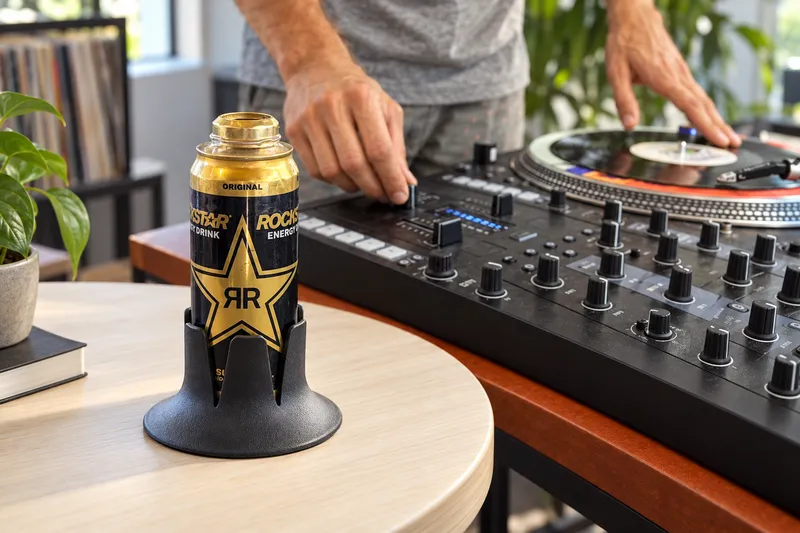
That is the narrow job here. A Steadi is one piece of Shore 85A TPU: a fixed base 5.2 inches across, with flexible fins that grip the bottom inch of whatever is standing in it. The mechanism is support footprint. A can stands on a base barely wider than the can; set it in a base 5.2 inches across and its centre of mass has to travel further sideways before it leaves that base, so a nudge that would have tipped the bare can may not tip this one. That is what resists tipping. It is not a mount, a clamp or a restraint, and it needs no pole, panel edge or table lip — which is why it goes on the boxed-in club counter and the scrim-covered folding table where a clamp has nothing to close on.
The physics is not why it belongs in this article. A designated spot with an object in it stops being a rule and becomes a place. An obvious cup holder on the guest side of the booth says "here, not there" without a sentence, in the dark, to somebody you never spoke to. That is reasoning about how designations work rather than a tested result — but it is the reasoning behind the drinks rails some venues have already built, and unlike a drinks rail it goes in the gig bag.
The limits run as long as the benefit. It holds one drink. It is not a barrier, and it does nothing about somebody reaching over the front lip of the booth. It cannot watch a glass parked somewhere else. It does not seal anything, and a direct hard knock still wins. It also wants a flat, level surface to be worth anything: the base does not deform, so on a ribbed coffin lid it bears on the ribs, the support it actually has is those few contact lines rather than 5.2 inches, and the whole assembly can rock about them. Nor is anything on top of a speaker cabinet made acceptable by being steady — that is where the drinks in this article kept ending up, and it is still the wrong surface. What fits is decided by the container's base rather than its rim, and that answer, including what does not fit, is on the fit page. US orders ship free, and there are 90 days from delivery to send it back, used, if it is not doing the job.
If what you actually came for is what a spilled drink costs and who ends up carrying it, that is a separate piece.
"No drinks in the booth" is a true statement about where a drink should not be, repeated for twenty years and never finished. The rooms that solved it did not say it louder. They built a ledge. You cannot pour a drinks rail into a room you are in for one slot — but you can decide before doors where the drinks go, and put something there that says so without you having to.
Checkout is on steadilabs.com — Steadi Labs is the company that makes it.