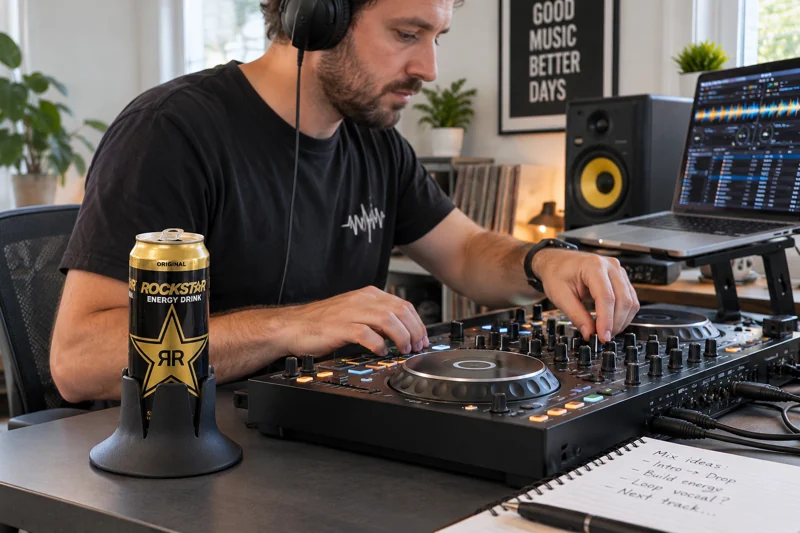
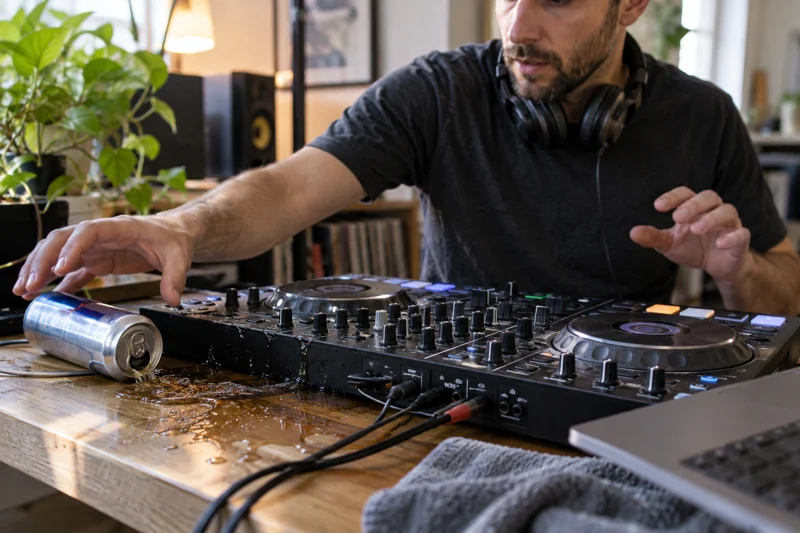
Finally, somewhere to put your drink at the decks.
4.9 from 119 Steadi reviewsA flexible-finned base that holds your cup, can, or tumbler steady on the booth counter, the folding table, or the desk — through bass vibration and an elbow reaching for the far deck. No clamp, no mic stand required.
Get one for the booth — from $14.9590 days behind the decks to test it at a real gig — free shipping, no fight if it's not for you.
Will your can fit next to the decks? A sticky note answers it — the test is below ↓

How it goes
'No drinks in the booth' exists because nobody built the drink a spot.
Every version of the booth — the club counter, the folding table behind the facade, the desk at home — is fully claimed by decks, mixer, and laptop before the drink even shows up. It ends up on the same surface as the fader bank because that's the only surface within reach.
A banquet table about waist height, dressed in a scrim, carrying the controller, the laptop, and the wireless-mic receivers all at once — and every sub on the dance floor sends its bass straight into it. A sweating can doesn't stay where it's set down; it rides the vibration toward the edge, toward the controller, over a set or two, while the DJ is watching the crowd instead of the can.
Two flagship decks and a mixer leave only a narrow strip of free counter, in the dark, right in the arc an elbow sweeps reaching for the far deck during a transition. Forum threads document the ending: a drink flung from the dance floor landing on a mixer and killing a channel fader; champagne going into a pitch fader at a party and gumming it for good.
Half the booth's spills aren't the DJ's own cup. A guest leans over the facade to make a request and leaves a glass by the laptop; someone reaches in at midnight to set a drink beside the decks 'just for a second.' Heads-down and cueing the next track, the DJ finds out the same way everyone else does — when it's already there, or already gone over.
A home rig crowds a controller, a laptop, and an interface onto one desk, with a mug — handle out, half-full — parked at the edge beside the pitch faders. Repair-guide traffic exists for exactly this: beer, coffee, and soda finding their way into jog wheels and fader slots, and the sugar in them corroding contacts long after the puddle's wiped up.
A sub cabinet at hand height, or a closed coffin case pressed into service as a side table — both get used because they're the closest flat thing to the rig. One is a loudspeaker built to vibrate a can right off its own edge; the other is ribbed and rarely level, and what's inside it is the backup gear the spill was supposed to miss.
None of it's a scandal. It's a drink defaulting to the only surface in reach — which happens to be the same one holding the gear that pays for the night.
Sound familiar
The set changes. This part of it never does.
The subs have been rattling the booth table for an hour. The energy can set down two songs ago has sweated a ring, gone top-heavy, and walked itself toward the edge behind the mixer — nobody notices until it drops.
The floor surges toward the booth and a guest leans over the facade to park a drink next to the decks, out of nowhere, mid-transition.
A guest leans in to ask for a track and leaves a glass beside the laptop on the way out. Heads-down and cueing the next song, the DJ finds it later — already sitting there, already a problem.
Corks pop near the booth and someone gets careless with a glass. It only takes a splash in the wrong fader to turn a toast into a factory-service ticket.
A long practice session at the desk, the coffee parked at the edge in whatever mug with a handle was closest. The reach for the far pitch fader during a transition sweeps an elbow straight through that same zone — the home version of the exact geometry that empties cans into club mixers.
The trick, explained
How it survives a subwoofer.
A slim energy can stands on a base only about two inches across — plenty for bass to walk. The wide, low base multiplies that contact patch, so the same vibration has to move something far bigger to get anywhere.
Flexible fins hold the can, bottle, or cup by its bottom inch — real grip, not suction — so a sweating drink stops sliding toward the mixer instead of slowly finding it.
An elbow reaches for the far deck, a guest leans on the facade, the changeover happens — the base takes the nudge and brings the drink back level instead of over the edge.
The 3-inch question
One sticky note settles it before the doors open.
lands in here
A square sticky note: 3 inches, exactly — same as the ceiling of what clears the booth counter.
The standard square is exactly 3 inches on a side — a fact about sticky notes, and also the exact ceiling of what fits in the base.
Right next to the deck, under the booth lights or at the practice desk — either tells the truth. Judge the bottom, not the rim; cans taper and glasses flare, and the base is the only measurement that counts.
Base lands inside the square, it fits. Hangs over the edges, it's too wide. A little puck lost in the middle — under 2 inches — it's too narrow.
No calipers, no spec sheet, no guessing under club lighting. One sticky note off the stack, one glance, with whatever's actually in your hand at the booth.
Will it fit my cup
The base decides what gets near the decks.
One line covers the whole lineup: a container base 2 to 3 inches across settles in. Here's how the booth checks out, drink by drink.
- Slim energy can (Red Bull and similar) fits
- 16 oz energy can (Monster and similar) fits
- Bar cup, handed over the facade fits
- Beer bottle, longneck fits
- Bottled water fits
- 40 oz Stanley-style tumbler fits
- Insulated camp cup, no handle fits
- Coffee mug, handled handle in the way
- Champagne flute too narrow
There's a floor as well as a ceiling. Under 2 inches — a champagne flute's narrow foot — it sits too loose to grip, and champagne has no business that close to the gear anyway. The handled mug is the honest exception on the practice desk: the base fits, but the handle lands exactly where a fin needs to close.
The full fit database — Stanley, Red Bull, Yeti, and 30 more, with sourced base measurements →
Read the rig
Every flat spot near the rig already belongs to something else.
Nobody's being sloppy. Every surface near a DJ rig is hard, dark, elbow-height, and — thanks to the subs — quietly moving the entire set.
A plastic banquet table about waist height, hidden behind a scrim, carrying the controller, the laptop, and the wireless-mic receivers at once. Low-frequency energy from the subs and the dance floor travels straight into it — the exact vibration that walks a can toward the controller over a set.
Hard, dark, and crowded: two flagship decks and a mixer leave only a narrow rim of free counter. Subs under or beside the booth put the vibration directly into the surface, right where elbows sweep during a transition.
A controller, a laptop, an audio interface, and cable clutter share the same elbow zone the pitch faders live in; a light controller gets knocked by a bumped desk as easily as the cup sitting next to it.
Flat, hand-height, and vibrating by design — it's the loudspeaker. It's also the nearest flat surface at most house parties, which makes it a machine built to walk a can right off its own edge.
Ribbed ABS with recessed latches, pressed into service as a side table at gigs, and rarely dead level. A can touches down at a few points, wobbles at rest, and tips at a nudge — right above the backup gear the spill was supposed to miss.
Why drinks tip over in the DJ booth — and what actually holds one steady — the full story →
The alternatives
The scene's already tried four fixes. None of them reach the table.
| A clamp-on stand cup holder | The DJ Cup Holder | |
|---|---|---|
| Mounts where the gear lives | Clamps to a mic stand or speaker pole — not a table | Sits right on the counter, table, or desk |
| Reach during a transition | An arm's reach out on the stand, off to the side | Right there on the same surface as the gear |
| Cup window | Some popular models cap out near 2.6 inches wide | About 2 to 3 inches — a real floor and ceiling |
| Holds through the bass | A rigid cradle on a pole the subs are shaking too | wide, low base resists tipping through the vibration |
| No mic stand nearby | Nothing to clamp to — no stand, no holder | Works on any hard flat surface, no pole required |
| Cost | A separate stand-mount gadget — another purchase to justify | One small piece, not another piece of gear |
| Counter space it needs | None — mounts entirely off the counter, on the stand | A small footprint on the counter, table, or desk |
Built to mount on a mic stand or a speaker pole — round tubing, not a flat surface — so it can't attach anywhere near the controller. The cup window on the popular ones runs narrow too, and the drink ends up arm's length away, riding a tripod that's also holding up a speaker.
A clip made for one manufacturer's booth panel, so it does nothing for a club counter, a folding table, or a home desk — and it hangs the drink off the front of the facade, the side facing the dance floor and every passing elbow.
The rule doesn't survive contact with a room full of people — the spills happen anyway. A separate drinks table keeps guests from reaching toward the gear, which helps, but it still leaves the DJ's own drink with nowhere to go but the floor, among the cables and the power strips.
Works exactly until the cap comes off to actually drink from it — and it rules out most of what a booth runs on anyway: energy cans, a bar cup handed over the facade, whatever a guest hands across.
From the reviews
What buyers say.
Recent reviews of the Steadi, from every room and rig it lives in.
I have a tendency to spill my drinks and have two cats. This is one of the best things I’ve ever impulse bought. It works. It actually works. It’s a heavy, wide enough base that it is actually stable. My “spot” in the living room is near a somewhat-cushioned fabric ottoman, which is where I usually put my drinks. It’s
Dixie · 2026-08-30I love mine. I just wish the price was more appropriate. $15 seems a lot for a small plastic item. Reduce it to $9.99 and free shipping and I'll buy a few more!
Carolyn G. · 2026-08-27Excellent!
Brian S. · 2026-08-27Thank you for your service!
Brian S. · 2026-08-27It’s great love it
gilbert a. · 2026-08-24I never knock over my water at night anymore!
Customer · 2026-08-21All 119 reviews are for the drink base itself, collected across every place people use it.
Why more than one
Two identical Stanleys. Whose is whose.
A B2B set means two DJs, two nearly identical 40 oz tumblers, and one narrow strip of shared counter. Neither one is labeled, both get parked in the same spot mid-transition, and the only way to tell them apart becomes a guess mid-set — or a mouthful of the wrong one.
Build your set
Give everyone their own.
Pick a pack, then give each one a color — so nobody has to ask which drink is theirs.
Fair questions
You're probably thinking…
One piece of molded flexible material — no hinge, no clamp arm, no hardware to work loose or snap. Molded in small runs in Orange, California, with 90 days to actually test it at real gigs before deciding.
The wide base multiplies the can's small footprint into something bass has to work far harder to move, and the fins grip from the sides instead of relying on friction alone. It resists tipping through vibration and elbow reaches — the demo video shows it happening, not just claims it.
The base decides it, not the rim — about 2 to 3 inches across settles in, named against what actually shows up at the booth: a Stanley, a Yeti, an Owala, a straight energy can. A sticky note off the stack confirms it in one glance.
Nothing to clamp to, period. It sits directly on the counter, the folding table, or the desk — wherever the rig actually lives, no pole required.
Nothing next to what one fried fader or a ruined laptop actually costs. Free shipping, and 90 days to send it back if it's not worth it.
Good to know
Questions from the booth, answered here.
Does it actually hold up on a booth counter?
It's built for exactly that kind of surface — hard, flat, and not going anywhere. The wide base spreads the contact so bass can't walk it toward the mixer, and the fins keep gripping through elbow reaches and quick handoffs, settling the drink back down instead of letting it slide.
Will bass vibration walk it off the table?
That's the exact failure this stops. A can's own base is small enough for a sub to walk it toward the edge over a set; the wide, low base spreads the contact so the same vibration has to move something far bigger, and the fins hold the drink from the sides the whole time.
Will my energy can or tumbler fit?
The base decides it, not the rim — 2 to 3 inches across settles in, and the 40 oz Stanley clears it easily. A handled mug is the one exception: its handle sits exactly where a fin needs to close, so it doesn't make the cut.
Does it clamp to a mic stand or the facade?
No — it doesn't clamp to anything. It sits directly on the counter, the folding table, or the desk, so it works wherever the rig is set up, not just wherever there's a pole to mount to.
Does this fix 'no drinks in the booth'?
It fixes the reason the rule existed — the drink finally has somewhere to stand that isn't the same slab as the fader bank. It resists tipping and settles back when it's bumped; it's still an open container, so a direct hit from a thrown drink is still a direct hit.
A guest's drink is the real risk at my gigs. Does this help with that?
Only the DJ's own drink lives in this — it can't watch a guest's glass parked by the laptop. What it does is take the DJ's cup out of the fader-bank lottery, which is one less drink in the danger zone during a changeover.
Will it fit in my gig bag or coffin case?
Yes. It's one flat piece of flexible material, no hardware, no stand — it packs flat with the rest of the setup and comes out in a second.
How do I clean it?
Rinse it, wipe it down, or put it in the dishwasher. It's one piece of material with nothing to take apart, unlike a fader.
Who makes it, and where do I buy one?
It's called the Steadi, molded in small runs in Orange, California by Steadi Labs — veteran-founded and patent pending. Every order ships free from steadilabs.com, with 90 days to change your mind.
Behind it
Molded closer than most of your gear.
The maker is Steadi Labs, a small veteran-founded company in Orange, California. It's injection molded in small runs, and nothing about it travels far — the mold, the material, and the color runs all sit within about three and a half miles of the shop, closer than most of what's on the booth counter ever came from. The people who make it read hello@steadilabs.com themselves, usually before their own first coffee of the day.
Ninety days at the booth to be sure.
Use it for a month — at the booth, on the folding table, wherever your rig actually lives. If it doesn't do what this page says, email hello@steadilabs.com and it gets made right — no forms, no fight.
Veteran-founded · Patent pending · Made in Orange, California
Retire 'no drinks in the booth.'
The cup stands on the counter through the bass and the changeover, the mixer stays dry — and 'no drinks in the booth' stops being a rule anyone has to enforce.
Add to cart — ships freeCheckout happens at steadilabs.com — that's Steadi Labs, the company behind it.